
Thursday, June 20, 2013
Vital vanguard, wonderful warriors: Marcus Books and Black Classic Press
Marcus Books, the legendary Black book store that for more than 50 years has been the intellectual heart of African American life in the Fillmore district in San Francisco, is facing a forced eviction -- or may have already been evicted -- as announced in a San Francisco Examiner article, "Marcus Books on the brink of closure" (June 9).
The Victorian residence at 1712 Fillmore St. that Marcus has occupied for years was purchased, and the new owners had an eviction notice issued to the store with a deadline to leave by the end of this week.
I haven't found an update on any action taken following the eviction deadline this week: Color of Change had a petition soliciting support for the Marcus Books at http://colorofchange.org/blog/2013/jun/17/action-help-save-oldest-black-bookstore/.
Stay tuned, or please share an update if you know what's going on now.
Even as the disheartening news of Marcus Books' crisis circulates, there is uplifting news about another Black book business that is surviving, even thriving.
An article in Publishers Weekly recently announced that Black Classic Press founded by publisher Paul Coates in Baltimore is celebrating its 35th anniversary with a series of events that included a book signing by Walter Mosley.
Congrats to you, Paul, and Black Classic Press on your 35th anniversary!
Academic institutions, k-12 and higher education institutions, do not adequately integrate narratives that highlight the presence and influence of people of African descent in Western culture and in world history. Black authors, Black publishers and Black book store owners are the vital vanguard, the wonderful warriors, who arm the community with knowledge that affirms our humanity and debunks myths and lies about our history.
The longevity that Marcus Books and Black Classic Press have accrued in the struggle is quantifiable and worthy of honor, but the real achievement of both institutions is their success in fostering self-realization and self-determination among Black people, and the impact of that achievement is immeasurable.


Sunday, August 12, 2012
The local bookstore you save must be your own
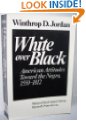 |
| White Over Black by Wintjrop Jrodan |
old Black bookstore in Harlem which closed at the end of July.
Hue-Man opened its doors with an attractive range of titles by Black authors on its shelves; I remember my first visit to the store, seeing a deep selection of African world history titles, by Dr. ben Jochanan and J.A. Rogers, for instance, as well as titles by contemporary Black authors such as Benilde Little, Mary Monroe (no relation -- I don't think!) and Pearl Cleage.
Hue-Man's selecton was impressive, but increasingly trends in the bookselling business
required more than just good books to sustain walk-in customers, ironically enough. Many
brick-and-mortars bookstores, including Hue-Man, adapted their marketing
strategies in order to increase walk-in traffic, or at least sustain their local and
devoted customer bases, which nonetheless were being drained by competitive online sellers.
The economic collapse that hit the U.S. in 2008 only steepened the slope that bookstores
(nearly all commercial entities) had to climb in order to survive, let alone thrive.
Independent bookstores adopted new strategies to sustain themselves: expanding their product
base, (products and/or adding eateries), hosting (more) author events, specializing in a
genre, even adding online selling, but like Hue-Man, many of these stores still closed
their doors.
So, what does it take in the current digital media environment for brick-and-mortar
bookstores to be able to serve their communities and be profitable?
A mix of the some of the strategies named above and as many as are effective in a local
community of readers. That's the other part, though--a community of readers has to be
committed to the bookstore culture. Readers have to want the bookstore culture, like the
bookstore culture, and be willing "to do bookstore culture," which means to take the walk or
15 minute ride to the store. Like we used to do and spend time and money there.
I am not chastising, but merely saying that the online selling industry has nearly
perfected the means that readers get books by delivering them directly to our doors. Can
it be that part of the answer to how bookstores survive is that readers collaborate with
many new ways to keep bookstore open, useful to the community and profitable?
In the last three weeks I have collaborated with a local bookstore, blackPrint Bookstore in New Haven, holding informal discussions around a civic curricula my sister and I created that has our group reading the U.S. Constitution and other founding documents of our country. Quite a rich discussion to have in a store filled with African-centered books and images. The discussion is enriched by the surroundings, and the events bring new visitors to the store and expand its branding as a venue for learning.
Holding a reading group in a bookstore, I know, is not new, but it is a way that I can commit to support my local bookstore, even as I pursue my own online bookselling.
The Huffington Post published an article that suggests 20+ ideas a bookstore/ community can
adopt to sustain its local bookstore, among them some very good ideas. Let me know, let
everyone know, if you recommend these to your local bookstore and if the store owners implement them, how things work out.
Revised July 11, 2013
Thursday, August 9, 2012
McDaniel and McQueen, in their own voices

An item in The Hollywood Reporter, July 31, 2012, noted that "a 1938 copy of Gone With the Wind signed by nearly the entire cast of the film sold for $135,300 ($110,000 plus $25,300 buyer's premium) ...."
Signatures of Hattie McDaniel who played "Mammy" in the movie, and Thelma "Butterfly McQueen," who played, "Prissy," are pictured below.


Hattie McDaniel won an Oscar in 1940 for best supporting actress in Gone With the Wind, which was released in theaters in 1939. Ms. McDaniel was the first African American actor to win an Oscar. Her acceptance speech was the epitome of dignity and self-possession. Hattie McDaniel's acceptance speech
In 1989, Thelma "Butterfly" McQueen was interviewed about "Prissy," the controversial maidservant she portrayed in Gone With the Wind. In the video, McQueen talks with dignity and frankness about her battle to overcome the toll that Hollywood stereotyping of Black women took on her career and personal life.
Monday, July 16, 2012
Save Black bookstores
News of Hue-Man Bookstore's closing later this month in Harlem continues to evoke dismay among readers and book lovers about the loss of that landmark store, in particular, and the loss of Black bookstores around the country. Recognizing the impact of bookstore closings on the Black community, L'Heureux Lewis-McCoy, an assistant professor of Sociology and Black Studies at the City College of New York, published a piece in Ebony, "Why We Must Save Black Bookstores."
Sunday, July 15, 2012
Education reform before the school bell rings
Dr. Camika Royal, a teacher and teacher coach of urban communities, spoke the unvarnished truth to about 700 soon to be Teach for America educators who will enter classrooms and hopefully serve as gateways to knowledge for students in need of inspiration, wisdom, and knowledge in the Philadelphia public schools. Here is an excerpt of her speech published in the Huffington Post.
Swift to Hear; Slow to Speak: A Message to TFA Teachers, Critics, and Education Reformers
For new teachers, understanding what is expected of them and the context in which they work is essential for their success and for the success of schools, students, and communities. It is because of this belief that I accepted the invitation to speak at the Opening Ceremonies for Teach For America's 2012 Summer Institute to train its new teachers in Philadelphia. I was asked to speak as a Teach for America alumnus but also as a Philadelphia community member. I thought this was an awesome opportunity and responsibility to speak to the more than 700 new teachers who are being trained.... read Camika Royal's the full speech in the Huffington Post.
Swift to Hear; Slow to Speak: A Message to TFA Teachers, Critics, and Education Reformers
For new teachers, understanding what is expected of them and the context in which they work is essential for their success and for the success of schools, students, and communities. It is because of this belief that I accepted the invitation to speak at the Opening Ceremonies for Teach For America's 2012 Summer Institute to train its new teachers in Philadelphia. I was asked to speak as a Teach for America alumnus but also as a Philadelphia community member. I thought this was an awesome opportunity and responsibility to speak to the more than 700 new teachers who are being trained.... read Camika Royal's the full speech in the Huffington Post.
Friday, July 6, 2012
50 books to read in the struggle

This morning I read an article in the Huffington Post, a suggestion of books that every African American should read.
The list of books, fiction and non-fiction, were chosen in
the context of books that would make good summer reading on vacation, at
the beach or traveling. Well enough.
I I suppose that for me the word, "should," overwhelmed the
otherwise casual context of the list. I began to think about what books I
would choose for a list of "the 50 books that every African American
should read."
Preparing lists of recommended books for the community to
read is rarely far from my thoughts. Since I was a child I've been
creating these lists of Black classics, first in response to my grammar
school readers that almost always marginalized Black characters or my young adult books that almost never listed a Black book in their "best of" lists on the back endpaper or back cover.
Through my college and grad school experience, literary works by Black
writers were sparsely explored in most of my classes. Some professors
gave balanced treatment of Black writers, but most professors (and most
of my professors were white) made only superficial exploration of Black
texts. I once had a professor who never met eye contact with me during
the entire semester until the one day that the class was assigned to
read Langston Hughes. On that day, he only looked at me as he
talked about Hughes. What was the message to my all white classmates?
"Black literature is for Black people; you don't have to worry about it"
is the conclusion that I drew.
This longstanding dearth of Black texts in my academic experience was certainly an influence on me when I began teaching
developmental writing, freshman composition and Black literature at a
community college in the 1990s.
Where the composition textbooks failed
to provide models of strong writing by Black writers, I filled in the
gaps. I used material by Dr. King, James Baldwin, Haki Madhubuti, poetry
by Gwendolyn Brooks, Robert Hayden and Paul Laurence Dunbar. My
students were apprehensive and perplexed about the Declaration of
Independence as assigned reading, but they understood the effectiveness of the rhetorical strategies that I pointed out, and later when we read Dr. King's "I Have a Dream" speech and material from the Black Panther's ten-point plan, they not only absorbed the continuity of certain rhetorical strategies in key American texts, but most importantly the content of some of those texts reflected their own cultural values and voice. In this way, my students' (the majority of them were black) cultural identity was validated because those black texts held equal weight with the texts by white writers published in their textbooks.
[Apologizes for the errant content that appeared here in an earlier draft of this post.]
That validation was palpable. Students really got into the texts, reading closely at home, looking up words, and coming into class saying that they couldn't wait to talk about what they read. The students practiced using these writers' strategies to give voice to their own ideas. This was all very exciting for them and for me, convincing me of the importance of balancing the selection of cultural voices used to teach college writing, just as our democracy is validated and our nation is served best when diverse voices are respected in our national conversations.
This list of books reflects the mission of Now Rise Books, to arm our community with cultural information and affirmation needed to participate in our national conversations that consider race, citizenship, cultural pride and contributions of many voices that represent contemporary America. Would appreciate hearing your comments and additional recommendations..
[Apologizes for the errant content that appeared here in an earlier draft of this post.]
That validation was palpable. Students really got into the texts, reading closely at home, looking up words, and coming into class saying that they couldn't wait to talk about what they read. The students practiced using these writers' strategies to give voice to their own ideas. This was all very exciting for them and for me, convincing me of the importance of balancing the selection of cultural voices used to teach college writing, just as our democracy is validated and our nation is served best when diverse voices are respected in our national conversations.
This list of books reflects the mission of Now Rise Books, to arm our community with cultural information and affirmation needed to participate in our national conversations that consider race, citizenship, cultural pride and contributions of many voices that represent contemporary America. Would appreciate hearing your comments and additional recommendations..
1. Aesop's Fables http://etext.virginia.edu/toc/modeng/public/AesFabl.html
2. The Book of Negro Folklore (Eds. Langston Hughes
& Arna Bontemps, 1958)
3. A Frances E(llen) W(atkins) Harper Reader
(Frances Smith Foster, 1990)
4. Reminiscences of School Life, and Hints on
Teaching (Fannie Jackson Coppin, 1913)
full text here: http://docsouth.unc.edu/neh/jacksonc/menu.html
5. On Lynchings (Ida B. Wells-Barnett, ed. by Norm
R. Allen, 2001, includes Southern Horrors, her first pamphlet on the subject.
Later, after moving to Chicago and marrying lawyer Ferdinand Barnett, she
brought out the pamphlets. A Red Record and Mob Rule in New Orleans)
6. Walker's Appeal, in Four Articles;
Together with a Preamble, to the Coloured Citizens of the World, but in
Particular, and Very Expressly, to Those of the United States of America,
Written in Boston, State of Massachusetts, September 28, 1829 (David
Walker, 1829)
7. Black Women in the Ivory Tower: 1850-1954: An Intellectual History
(Stephanie Y. Evans, 2008)
8. Beloved (Toni Morrison, 1987)
9. Their Eyes Were Watching God (Zora Neale Hurston,
1937)
10. The
Collected Poems of Sterling Brown (1990)
11. The
Autobiography of an Ex-Colored Man (James Weldon Johnson, 1927 [1912])
12. The
Book of Negro American Poetry, Revised Edition (ed., James Weldon Johnson,
including the "Preface" to the 1st edition, 1931)
13. Notes
on the State of Virginia (Thomas Jefferson, 1832)
start with this excerpt: http://www.historytools.org/sources/Jefferson-Race.pdf
o Notes
on the State of Virginia -- http://etext.virginia.edu/toc/modeng/public/JefVirg.html
o Notes
on the State of Virginia "Laws"The administration of justice and
description of the laws?
Laws - http://etext.virginia.edu/etcbin/toccer-new2?id=JefVirg.sgm&images=image
s/modeng&data=/texts/english/modeng/parsed&tag=public&part=14&division=div1
14. The
Declaration of Independence (Thomas Jefferson, et al, 1776)
15. "I
Have A Dream" speech, Dr. Martin Luther King, Jr. (I Have A Dream, ed.
James Melvin Washington, 1992)
16. Seize
The Time, (Bobby Seale, 1970) see Black Panther Party Ten Point plan announced
by Bobby Seale: YouTube http://www.youtube.com/watch?v=LPP0hiLuxdQ
17. Black
Studies in the University (eds. Armstead L. Robinson, Craig C.Foster, Donald H.
Ogilvie, 1969)
18. How
Europe Underdeveloped America (Walter Rodney, 1972)
19. The
Mis-Education of the Negro (Carter G. Woodson, 1933)
20. Brainwashed
(Tom Burrell, 2011)
21. Negro
with a Hat: The Rise and Fall of Marcus Garvey (Colin Grant, 2010)
22. The
Wretched of the Earth (Frantz Fanon, 1963 translation)
23. Africa's
Gift to America (J[oel] A[ugustus] Rogers, 1961)
24. Jesus
and the Disinherited (Howard Thurman, 1949)
25. They
Came Before Columbus (Ivan van Sertima, 1976)
26. The
African Origin of Civilization: Myth or Reality, (Cheikh Anta Diop, 1967)
27. The
Fire Next Time (James Baldwin, 1963)
28. Brown
sugar : eighty years of America's Black female superstars (Donald Bogle, 1980)
29. Black
Men: Obsolete, Single, Dangerous?: Afrikan American families in transition :
essays in discovery, solution, and hope / (Haki Madhubuti, 1990)
and The Bill of Rights http://www.archives.gov/exhibits/charters/bill_of_rights_transcript.html
31. Before
the Mayflower: A History of the Negro in America, 1619-1962 (Lerone Bennett Jr.,
1962)
32. The
Black Poets (Dudley Randall, 1971)
33. Unbought
and Unbossed (Shirley Chisholm, 1970)
34. The
Emancipation Proclamation (Abraham Lincoln, 1863)
35. Stride
Toward Freedom (Martin Luther King, Jr., 1955) and Where Do We Go From Here,
(Dr. Martin Luther King, Jr., 1967)
36. The
Lonely Londoners (Sam Selvon, 1956)
37. Hamlet
(1603) and Romeo & Juliet (1597) (William Shakespeare)
38. The
Collected Stories of Katherine Anne Porter (Katherine Anne Porter, 1984)
39. Nile
Valley Contributions to Civilization: Exploding the Myths (Anthony T. Browder,
1992)
40. Huckleberry
Finn (Mark Twain, 1885)
41. The
House on Mango Street (Sandra Cisneros, 1984)
42. Common
Sense (Tom Paine, 1784)
43. The
Sun Also Rises (Ernest Hemingway, 1926)
44. Sojourner
Truth: Speech to the Women’s Rights Convention in Akron, Ohio, 1851
45. Narrative
of the Life of Frederick Douglass, an American Slave, Written by Himself
(Frederick Douglass, 1845)
46. The
Joy Luck Club (Amy Tan, 1989)
47. A Different Drummer (William Melvin
Kelley, 1962)
48. A’int
I a Woman: black woman and feminism (bell hooks, 1981)
49. A
Small Place (Jamaica Kincaid, 2000)
50.Brothers
and Sisters (Bebe Moore Campbell, 1995)
Last updated on July 10, 2012
Last updated on July 10, 2012
Tuesday, July 3, 2012
Stop to start: Hue-Man Bookstore closing
 |
| Dr. Poussaint and Biil Cosby, November 2007 |
Of course, the decision that owner Marva Allen has made -- to abandon the traditional brick-and-mortar model bookstore in order to consider how to re-invent their bookselling presence in a technology dominated world -- is practical, proactive even. However, the decision leaves a void in the community where her store, the largest Black bookstore in Harlem, was a coveted destination.
The news is disappointing beyond Harlem, too, like here in New Haven. Lots of folks in Connecticut followed events at Hue-Man; the store was their bookstore away from home. I have hopped on the Metro-North train to travel to a number of events at Hue-Man, such as the Bill Cosby and Alvin Poussaint booksigning (pictured). I saw folks from Bridgeport, CT at the Cosby and Poussaint event that evening. I've seen folks from Connecticut on other occasions at the store, too. As I did with Liberation Bookstore, also gone now, I have made a point of visiting the Hue-Man many times when I was in the city on other business.
In her letter to the Hue-Man patrons, Marva Allen left readers to think about how booksellers that cater to Black interests will transform themselves to serve a readership that increasingly accesses books and information across many platforms, not just through a book store. With the loss of another venue, I consider how we as readers will make new conventions to sustain the cultural exchanges that took place when we flocked to our favorite bookstore to celebrate the release of a high-profiled book, at readings and at events to talk about a pressing community issue? How will we replace the cultural and intellectual impact that the iconic Black bookstore has had in our communities?
Subscribe to:
Posts (Atom)